

Stock Exchange – What is NSE and BSE?
Have you ever heard of the stock exchange, Nifty, Sensex? Have you ever heard of the Dalal street or the D Street? Let us understand these terms.
DALAL STREET
Dalal Street, in Mumbai, India is the address of the Bombay Stock Exchange, the biggest stock exchange in India and several related financial firms and institutions. When Bombay Stock Exchange was moved to this new location at the intersection of Bombay Samachar Marg and Hammam Street, the street next to the building was renamed as Dalal Street.
The Hindi word Dalal means “a broker”. The term “Dalal Street” is used in the same way as “Wall Street” in the U.S., referring to the country’s major stock exchanges and overall financial system.
In order to understand what is nifty and sensex, we need to understand the Indian stock exchanges first.
Now, let’s discuss the two major stock exchanges in India i.e. the ‘Bombay stock exchange’ and the ‘National stock exchange’
Bombay Stock Exchange (BSE)
Bombay stock exchange is an Indian stock exchange located at Dalal Street, Mumbai, Maharashtra.
It was established in 1875 and is Asia’s oldest stock exchange.
It is the world’s fastest stock exchange, with a median trade speed of 6 microseconds.
The BSE is the world’s 11th largest stock exchange with an overall market capitalization of $1.43 Trillion as of March, 2017.
More than 5500 companies are publicly listed on the BSE.

Image Source – Internet
National Stock Exchange (NSE)
The National Stock Exchange (NSE) is the leading stock exchange of India, located in Mumbai, Maharashtra, India. It was started to end the monopoly of the Bombay stock exchange in the Indian market.
NSE was established in 1992 as the first de-mutualized electronic exchange in the country.
It was the first exchange in the country to provide a modern, fully automated screen-based electronic trading system which offered an easy trading facility to the investors spread across the length and breadth of the country.
NSE has a total market capitalization of more than US$1.41 trillion, making it the world’s 12th-largest stock exchange as of March 2017.
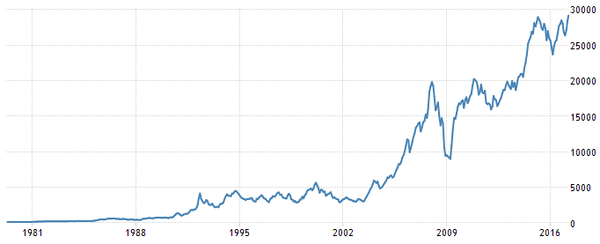
Image Source – Nifty Historical Data
What is ‘Market Index’ ?
A market index is an aggregate value produced by combining several stocks or other investment vehicles together and expressing their total values against a base value from a specific date. Market indexes are intended to represent an entire stock market and thus track the market’s changes over time.
Index values help investors track changes in market values over long periods of time. Investors can track changes in the index’s value over time and use it as a benchmark against which to compare their own portfolio returns.
Importance of Market Index :
The market indexes are the barometer for the market behaviour. It gives a general idea about whether most of the stocks have gone up or gone down.
Often, Market Index is used as a benchmark portfolio performance.
It is used as a reflector of investor’s sentiments.
Market indexes are used for sorting and comparison of the various companies.
They are used in passive fund management by Index funds.
Bombay Stock Exchange (BSE) and National Stock Exchange (NSE) also have their respective market index, i.e., SENSEX (BSE) and NIFTY (NSE).
SENSEX
The SENSEX-(or SENSitve indEX) was introduced by the Bombay stock exchange on January 1, 1986. It is one of the prominent stock market indexes in India. The Sensex is designed to reflect the overall market sentiments. It comprises of 30 stocks. These are large, well-established and financially sound companies from main sectors.
As of March 15, 2017, the Full Market capitalization of Sensex is 4,986,299 crores and the free float market capitalization is Rs. 2,687,777 crores.
NIFTY
Nifty is a major stock index in India introduced by the National stock exchange. NIFTY was coined from the two words ‘National’ and ‘FIFTY’. The word fifty is used because; the index consists of 50 actively traded stocks from various sectors.

Image Source – Internet
The Sensex and Nifty are both indicators of market movement. If the Sensex or Nifty go up, it means that most of the stocks in India went up during the given period.
With respect to NIFTY and NSE, we can say that:
If Nifty goes up, this means that the stock price of most of the major stocks on NSE has gone up.
If Nifty goes down, this tells you that the stock price of most of the major stocks on NSE has gone down.
When Sensex/Nifty increases, it shows economic growth of the country.
Now, we have the basic idea that what is Sensex, Nifty and market index. In the upcoming next article of this series, we will understand, how Sensex and Nifty works.
Kailasha Foundation – Bringing Solutions To You
Follow us on Facebook, Twitter, Instagram, LinkedIn for regular updates.

Comment ( 1 )
[…] In the previous article of this series, we have learned about the Market Index, Stock Market, NSE and BSE. […]